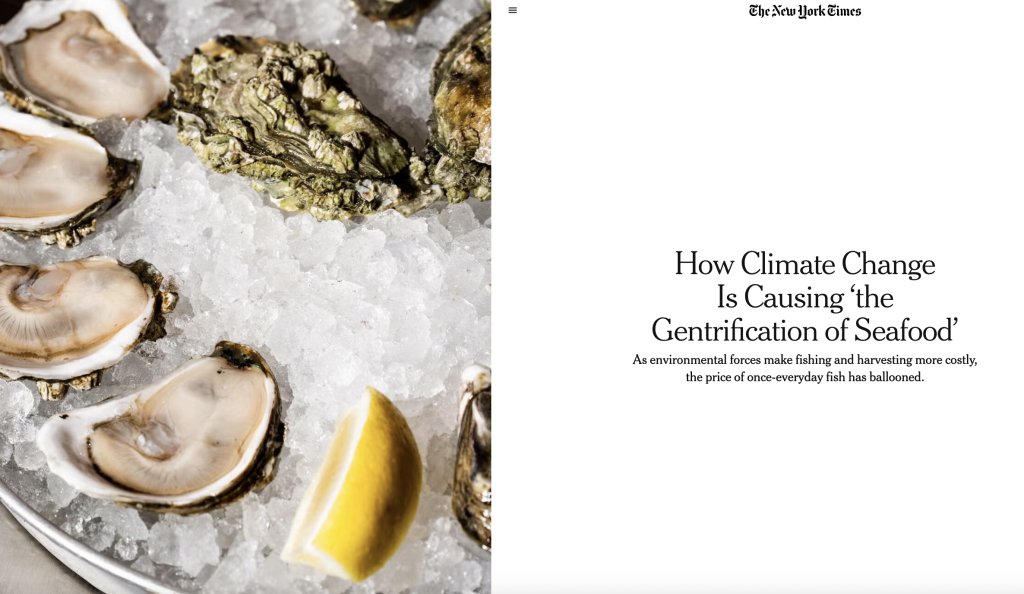
The story begins: “David Leck, who buys the oysters for Elliott’s Oyster House in Seattle, loves the mellow finish of Baywater Sweet oysters and the metallic tang of tiny Olympias, but he’s most partial to oysters he remembers from growing up.
His parents used to drive him a few hours west to Hood Canal, where he would harvest them from the beach and shuck them with a screwdriver.
“There were so many oysters out in the places where now they’re so scarce,” he said. “You couldn’t walk without oysters everywhere.”
His family also dug for clams, threw out crab pots and fished for salmon, but you can’t really live that way now, he said. Summers are warmer. More people are going after fewer fish and shellfish.
With crabs, clams and oysters, you have to be more careful than you used to about bacteria and toxic algae that can make you sick, so harvest times are more limited. It’s safer to buy shellfish from restaurants and farmers who test for health hazards. But, that’s gotten pricey. Oysters that were $1 apiece not so long ago are now $4.50.
Growing up, he could never have imagined the world of the highbrow oysters where he works. “It’s crazy the shift of it all,” Mr. Leck said.
Stroll through nearby Pike Place Market and you’ll find that many once-everyday fillets and crab claws have become prohibitively expensive. In 2016, Alaska red king crab in Seattle markets fetched $25 to $45 per pound, but a marine heat wave began soon after that in Bristol Bay, where crabs were already in decline, leading to a crash in the population. Today, the crab, which has not yet recovered, retails for as much as $150 to $160 a pound.
Whole Washington Dungeness crab in 2016 was $8 to $13 a pound. Warmer water contributed to a rash of crab die-offs, and warm water related algae blooms can also shut down crab fishing. Those crabs now average $25 a pound. King salmon populations in Alaska’s famous Copper River have been falling for almost 20 years, in part because of heat-related stresses. Over the summer, a single 25-pound fish from those waters cost $2,000.
Seafood prices have never been stable. Forces like inflation, geopolitical tensions, regulation changes, international market shifts, fuel and labor costs always fluctuate. But over the last 20 years, climate change-related phenomena have added steady pulses of volatility. A pattern of disruption from droughts, heat domes, marine heat waves, sea ice anomalies, ocean acidification, atmospheric rivers and toxic algae blooms has upended the rhythms of most commercial seafood species in the Pacific Northwest.
That’s changing how people eat, with many weeknight food items becoming just occasional splurges, if not entirely unaffordable.”